

A sourcing manager has five factory quotes for one denim jacket, three in email threads and two in spreadsheets. Each uses a different currency, a different trim list and a different delivery date. Then a new tariff lands mid-season and every number has to be checked again.
An apparel sourcing system is software, often a module inside a fashion PLM, that manages supplier selection, requests for quote (RFQs), costing, sample approvals, supplier scorecards and compliance records in one place.
The pressure behind this shift is clear. In The State of Fashion 2026, The Business of Fashion and McKinsey report that executives name tariffs as their number-one hurdle for 2026, and 46% expect industry conditions to worsen.
This guide explains what an apparel sourcing system does, its core features, the sourcing workflow, how it compares with PLM and ERP and how to choose one.
What Is an Apparel Sourcing System?
An apparel sourcing system is software, often a module inside fashion PLM, that manages supplier selection, requests for quote (RFQs), costing, sample approvals, supplier scorecards and compliance records in one place. It connects product data from PLM to purchase orders in ERP, so brands can compare vendors on landed cost, quality, lead time and risk.
In simple terms, the system answers one question for every style: which supplier should make it, at what cost and with what proof that the factory meets the brand’s standards.
Who Uses an Apparel Sourcing System
Several teams work in the same sourcing system, each for a different reason:

Sourcing and buying teams: Send RFQs, compare quotes and award styles to suppliers.
Product development teams: Share tech packs, track sample rounds and record fit comments.
Merchandising teams: Check that the agreed cost still meets the target margin for each style.
Compliance and sustainability teams: Keep audit reports, certificates and origin documents current.
Finance teams: See landed cost and expected profit margins before a purchase order is raised, not after the invoice arrives.
Apparel Sourcing System vs. Sourcing Marketplace
An apparel sourcing system manages a brand’s own supplier base, while a sourcing marketplace (often called a garment sourcing platform) helps brands discover new suppliers. A marketplace works like a directory. A sourcing system is where approved suppliers receive RFQs, submit quotes and samples and build a performance history. Many brands use both: the marketplace to find a new knit mill and the sourcing system to qualify and manage it.
Why Apparel Brands Need a Sourcing System in 2026
Apparel brands need a sourcing system in 2026 because tariffs, trade rules and supply chain laws now change faster than spreadsheets can track. Every change in duty rates or compliance rules alters which supplier is cheapest and which supplier is allowed.
From Tactical Buying to Strategic Sourcing
Tactical buying picks the lowest unit price for this season’s order. Strategic sourcing looks at total cost, risk, capacity and supplier performance across seasons. A sourcing system makes this shift practical because quote history, sample results and delivery records sit in one place. When a buyer reviews a polo shirt for next season, the team can see last season’s on-time delivery and defect rate next to the new quote. Growth is usually what forces the change.
Pivot Apparel, a New York sourcing and design company with production across Cambodia, China, India, Mexico and Pakistan, ran on Excel, email and manual coordination until it reached nearly 2,400 articles a year. Duplicate style tracking, sampling by email thread and tech pack errors pushed it to move development and supplier collaboration into one PLM system, and it now handles more than 10,000 articles a year across seven brands.
Tariff Changes and Multi-Country Sourcing
US tariff rules for apparel imports shifted more than once in 2026:
- February 2026: The US Supreme Court struck down tariffs imposed under the International Emergency Economic Powers Act (IEEPA), and Retail Dive reported that a temporary 10% Section 122 import surcharge would take its place until 24 July.
- July 2026: The Office of the United States Trade Representative (USTR) applied new Section 301 tariffs from 24 July 2026, generally at 10% or 12.5%, on 60 economies, according to law firm Clark Hill.
- Apparel quotas: The same Clark Hill update notes that USTR plans tariff-rate quotas for certain textile and apparel products from Bangladesh, Cambodia, Indonesia and Malaysia.
As tariffs and trade regulations continue to change, brands diversify their sourcing strategies through dual sourcing, China Plus One strategies, and nearshoring. A sourcing system helps buyers compare sourcing options by maintaining duty rates based on the country of origin and recalculating landed costs for quotes from Vietnam and Guatemala within minutes.
Supply Chain Regulation Pressure
Three rules now shape which suppliers a brand can use and how it handles stock:
- EU destruction ban: The European Commission states that from 19 July 2026, large companies in the EU can no longer destroy unsold clothes, clothing accessories and footwear, with medium-sized companies following in 2030.
- EU Forced Labour Regulation: The European Commission confirms that from 14 December 2027, products covered by the regulation cannot be sold in or exported from the EU.
- US UFLPA: U.S. Customs and Border Protection presumes goods made wholly or partly in Xinjiang, or by listed entities, are barred unless the importer shows clear and convincing evidence otherwise.
Each rule needs supplier and material records that a sourcing system can hold and report on.
Core Features of an Apparel Sourcing System
An apparel sourcing system brings seven features together so sourcing decisions use the same data from first quote to final order:

- Supplier onboarding and vendor management: Store supplier profiles, capabilities, capacity and approval status.
- RFQ and bid comparison: Send one request to many suppliers and compare answers side by side.
- Costing: Build cost sheets and calculate FOB and landed cost for every quote.
- Sample management: Track every sample round from proto to top of production.
- Vendor scorecards: Rate suppliers on delivery, quality and responsiveness.
- Compliance records: Keep audits, certificates and origin documents with expiry alerts.
- PO handoff: Pass the awarded supplier and agreed cost to ERP.
Supplier Onboarding and Vendor Management
An RFQ in apparel sourcing sends the tech pack, bill of materials (BOM), target cost, quantities and delivery window to shortlisted suppliers. Suppliers enter quotes in the same format, so the sourcing team compares like with like. A side-by-side view shows price, lead time, minimum order and fabric source for each response.
An RFQ is only as good as the tech pack behind it. JOG Group, the Dutch group behind Jeans Centre, Garcia and CHASIN’, found that each brand’s design team used its own tech pack format, which confused suppliers. Moving all three brands onto one PLM gave more than 60 designers a single, standard tech pack format.
Costing: Cost Sheets, FOB and Landed Cost
An apparel cost sheet breaks a garment price into fabric, trims, cut, make, trim (CMT), washing or finishing, packaging, overhead and supplier margin. Two production models shape this sheet:
- CMT:The brand supplies fabric and trims, and the factory charges for cutting, sewing and finishing.
- Full package (FOB): The factory sources materials and delivers finished goods at an agreed price.
Free On Board (FOB) is an Incoterms rule. The International Chamber of Commerce defines FOB as the seller delivering goods loaded on the buyer’s vessel at the port of shipment, with the seller handling export clearance. FOB applies to sea and inland waterway transport only.
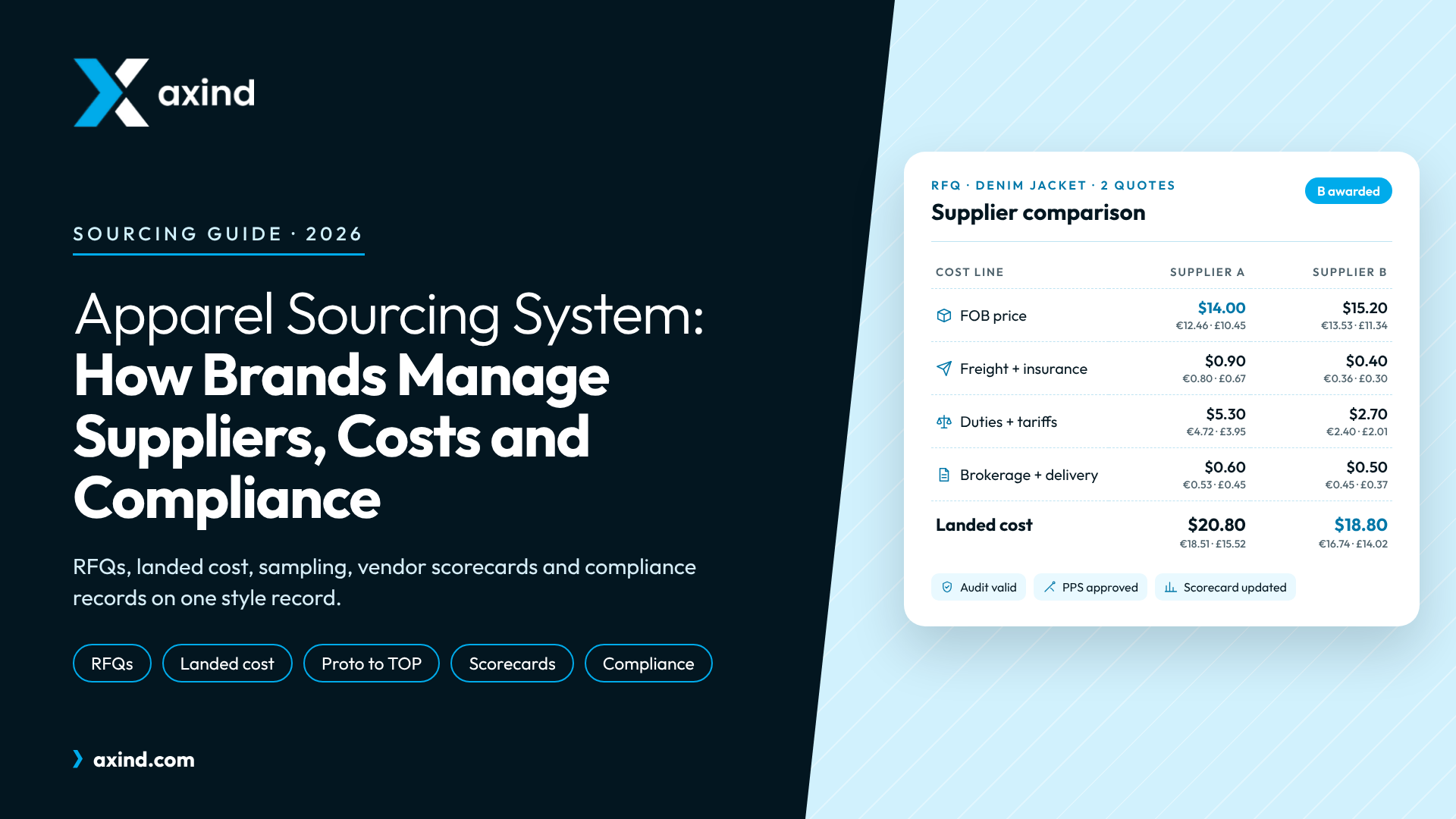
Landed cost adds everything after loading. The worked example below uses illustrative numbers, not market rates. Values are set in US dollars (USD) and converted to euros (EUR) and pounds sterling (GBP) at the European Central Bank reference rates for 21 October 2026 (1 EUR = 1.1234 USD = 0.83825 GBP):

|
Cost line (one denim jacket)
|
Supplier A (USD / EUR / GBP)
|
Supplier B (USD / EUR / GBP)
|
|---|---|---|
|
FOB price
|
$14.00 / €12.46 / £10.45
|
$15.20 / €13.53 / £11.34
|
|
Ocean freight and insurance
|
$0.90 / €0.80 / £0.67
|
$0.40 / €0.36 / £0.30
|
|
Duties and tariffs (illustrative rates)
|
$5.30 / €4.72 / £3.95
|
$2.70 / €2.40 / £2.01
|
|
Brokerage, port fees, inland delivery
|
$0.60 / €0.53 / £0.45
|
$0.50 / €0.45 / £0.37
|
|
Landed cost
|
$20.80 / €18.51 / £15.52
|
$18.80 / €16.74 / £14.02
|
Supplier A wins on FOB. Supplier B wins on landed cost by $2.00 (about €1.78 or £1.49) per unit. Across 20,000 units, that gap is $40,000 (about €35,600 or £29,850), which is why sourcing teams compare the landed cost. Converted figures are rounded to two decimals, so totals may differ by one cent or penny from a direct conversion.
Sample Management: Proto to TOP
Sample management tracks each physical sample, who approved it and what changed. Most apparel orders move through these stages similar to the following:

|
Sample type
|
Purpose
|
Usually approved by
|
|---|---|---|
|
Proto sample
|
Check design and construction
|
Design, product development
|
|
Fit sample
|
Check fit on a model or form
|
Technical design
|
|
Size set
|
Check grading across sizes
|
Technical design
|
|
Salesman sample (SMS)
|
Show to buyers and sales teams
|
Merchandising
|
|
Pre-production sample (PPS)
|
Confirm final fabric, trims and workmanship before bulk
|
Product development, quality
|
|
Top of production (TOP)
|
Confirm bulk matches the approved PPS
|
Quality
|
Vendor Scorecards: Lead Time, Defect Rate, On-Time Delivery
Apparel supplier management depends on facts, not memory. A vendor scorecard tracks on-time delivery, defect or reject rate, production lead time, quote accuracy against actual cost, sample approval rounds and audit status. Scores update from real order and inspection data.
Compliance and Certification Records
Compliance records hold audit reports, certificates, restricted substances list (RSL) test results and origin documents for each supplier and material. Expiry alerts warn the team before a certificate lapses, at a lead time the brand sets.
PO Handoff and ERP Integration
Once a style is awarded, the sourcing system passes the supplier, agreed cost, quantities and delivery dates to Enterprise Resource Planning (ERP) as a purchase order. This removes retyping and keeps the cost the brand approved as the cost the brand pays.
For buying agents and manufacturers, the order flow starts one step earlier, with buyer orders that often arrive as long PDF files. ZXY International, a buying and sourcing company that receives hundreds of buyer orders a day, some with up to 200 styles, cut processing from hours to minutes per order batch by extracting order data automatically. Simple Approach in Hong Kong uses the same approach to flag every buyer revision, so production no longer follows an outdated specification.
The Apparel Sourcing Workflow, Step by Step
The apparel sourcing workflow runs in six steps, from qualifying a supplier to scoring its delivery. Compliance comes first because a supplier that fails an audit should never receive an RFQ:

- Vendor qualification and compliance gate: Check audits, certifications and capacity before a supplier joins the approved list.
- RFQ issue: Send the tech pack, BOM, target cost and delivery window to qualified suppliers.
- Quote comparison and cost negotiation: Compare FOB and landed cost against the target margin, then negotiate.
- Sampling and approvals: Approve proto, fit, size set and PPS samples, plus lab dips and strike-offs.
- Vendor award and PO handoff to ERP: Confirm the supplier and pass the purchase order to ERP.
- Production follow-up and scorecarding: Approve the TOP sample, review inspections and feed delivery data into the vendor scorecard.
Compliance monitoring runs through every step, not once. If a factory’s certificate expires during sampling in step 4, the system flags the style before the PO is raised in step 5.
Step 6 depends on time and action (T&A) tracking, the calendar of milestones from order to shipment. The Experience Group, an apparel manufacturer and sourcing agent with factories in Bangladesh, found that Excel T&A calendars showed delays only after they happened. After moving its whole merchandising team to a shared, web-based T&A system, it reports 99% on-time delivery.
Apparel Sourcing System vs. PLM vs. ERP vs. SRM
An apparel sourcing system sits between Product Lifecycle Management (PLM) and ERP: PLM defines the product, the sourcing system picks the supplier and cost, and ERP runs the order. Supplier Relationship Management (SRM) and sourcing marketplaces cover narrower jobs. A sourcing system is often a part of the PLM.

|
System
|
Main job
|
Key data
|
Main users
|
Place in the flow
|
|---|---|---|---|---|
|
PLM
|
Design and develop the product
|
Tech packs, BOMs, materials, specs
|
Design, product development
|
First
|
|
Apparel sourcing system
|
Choose supplier and agree cost
|
Quotes, cost sheets, samples, audits
|
Sourcing, compliance
|
Second
|
|
SRM
|
Manage supplier relationships broadly
|
Contracts, spend, supplier risk
|
Procurement
|
Along side sourcing
|
|
ERP
|
Run orders, stock and finance
|
POs, inventory, invoices, payments
|
Operations, finance
|
Third
|
|
Sourcing marketplace
|
Find new suppliers
|
Supplier listings, categories
|
Sourcing
|
Before qualification
|
In many fashion companies, sourcing runs as a module of PLM rather than a separate tool, because quotes and samples belong to the same style record as the tech pack and BOM.
Fashion Supply Chain Compliance and Traceability
Fashion supply chain compliance means proving where a garment and its materials were made, under what conditions and to what standard. An apparel sourcing system stores that proof at supplier and material level, so the brand can answer a customs query or a regulator without searching inboxes.
Tier 1 to Tier 4 Traceability
Apparel supply chains are usually described in four tiers:

- Tier 1: Garment assembly, where cutting, sewing and finishing happen.
- Tier 2: Fabric production and processing, such as weaving, knitting, dyeing and printing.
- Tier 3: Yarn spinning.
- Tier 4: Raw materials, such as cotton farming or the production of synthetic raw materials.
Most brands know their tier 1 factories well. Visibility at tiers 3 and 4 is still partial for many brands. Rules such as UFLPA cover goods made wholly or partly in a restricted region, so the origin of raw materials at tier 4 matters as much as the sewing factory. A sourcing system helps by linking each style to its fabric mill and yarn source, then storing the documents that prove origin.
Social and Environmental Audits
Social and environmental audits give brands a common way to check factories. The main audits and standards a sourcing system tracks include:
- SMETA: Sedex describes the Sedex Members Ethical Trade Audit as a social audit methodology carried out by approved third-party audit companies, covering workers’ rights and health and safety, with environment and business ethics in the 4-Pillar version. SMETA is an audit, not a certification.
- WRAP: Worldwide Responsible Accredited Production certifies production facilities against its 12 Principles for social compliance.
- Higg Index: Cascale owns the Higg Index, which Worldly delivers as exclusive licensee. The Higg Facility Environmental Module (FEM) covers energy, emissions, water, waste and chemicals, and the Higg Facility Social & Labor Module (FSLM) covers areas such as wages, working hours and health and safety.
Even testing and certification bodies face the same coordination problem. Eurofins BLC, the fashion and textile testing, inspection and certification division of Eurofins Scientific, moved more than 100 suppliers across more than 20 countries from scattered files into one shared system, with supplier documents held against each product.
Digital Product Passport Readiness
As of October 2026, the European Commission DPP timeline plans adoption of the textiles delegated act in Q3 to Q4 2027, followed by a transition period of at least 18 months. The same timeline lists the EU DPP registry as operational from 20 July 2026.
The Commission’s textile apparel DPP page says the passport may include material composition, origin, repair and care information, end-of-life information and compliance documents. Exact fields will be set in the delegated act, so brands can start collecting this data at supplier level now.
How AI Is Changing Apparel Sourcing
AI is changing apparel sourcing by checking quotes, supplier data and trade rules faster than a team can by hand. Most reported generative AI use in fashion is still outside sourcing: The State of Fashion 2026 reports that more than 35% of executives already use generative AI, mostly in customer service, imagery, copywriting and product discovery.
In sourcing, the most practical uses today are:
- Quote checks: Flag a quote that is far above or below similar styles from the same supplier.
- Supplier risk alerts: Watch news, sanctions lists and entity lists for named suppliers and sub-suppliers.
- Cost sheet drafting: Pre-fill a cost sheet from the BOM and past quotes for review.
- Tariff scenarios: Re-run landed cost for each origin country when duty rates change.
- RFQ drafting: Turn a tech pack into a structured RFQ with the right attachments.
A buyer still makes the award. AI shortens the time between a tariff notice and a revised sourcing plan, but supplier choice stays a human decision with a clear record of why.
How to Choose an Apparel Sourcing System: Buyer Checklist
To choose an apparel sourcing system, check how well it connects to PLM and ERP, how it handles landed cost and compliance and how easily suppliers can use it. Use this checklist in vendor demos:

- PLM link: Quotes, samples and costs attach to the same style record as the tech pack and BOM.
- Supplier portal: Suppliers enter quotes, upload documents and reply to sample comments themselves.
- Landed cost engine: Duty rates by country of origin, freight and fees are editable when tariffs change.
- Multi-currency: Quotes in different currencies convert at a set exchange rate.
- Bid comparison: Side-by-side view of price, lead time, MOQ and fabric source.
- Sample tracking: Every round from proto to TOP, with comments and photos.
- Vendor scorecards: Scores fed by real PO and inspection data.
- Compliance records: Audit and certificate storage with expiry alerts, linked to suppliers and materials.
- Traceability depth: Links from tier 1 down to fabric mill and raw material source.
- DPP data readiness: Fields for material composition, origin and care that can feed a future passport.
- ERP connector: Awarded cost and supplier pass to ERP as a PO without retyping.
- Roles and access: Suppliers see only their own RFQs and styles.
- Reporting: Dashboards for cost variance, sample rounds and supplier performance.
- Rollout and support: A realistic implementation plan, training and named support contacts.
A system that ticks the PLM link, landed cost and compliance boxes covers the three areas where spreadsheets fail first.
Implementation and ROI: What to Measure
The ROI of an apparel sourcing system shows up in shorter sourcing cycles, fewer sample rounds and costs that hold from quote to invoice. To prove it, brands should record a baseline for each KPI before go-live and compare after one or two seasons.
|
KPI
|
What it measures
|
How to calculate
|
|---|---|---|
|
RFQ cycle time
|
Speed from RFQ issue to supplier award
|
Days from RFQ sent to award date
|
|
Sample rounds per style
|
Development efficiency
|
Total sample rounds divided by styles developed
|
|
Costing accuracy
|
How well quotes predict real cost
|
Quoted landed cost vs. actual landed cost, per style
|
|
On-time delivery
|
Supplier reliability
|
POs delivered on or before the agreed date, as a share of all POs
|
|
Chargebacks and claims
|
Quality and compliance failures
|
Value of chargebacks per season
|
|
Audit coverage
|
Compliance reach
|
Active suppliers with a current audit, as a share of all active suppliers
|
Consolidation is often where the biggest gain sits. One Friday, a children’s fashion brand that designs in Milan and manufactures in Asia, replaced three to four disconnected tools, including Excel-based design coordination, with one platform covering development, supplier collaboration, production timelines and sales.
When a brand builds the business case, the same KPIs become the targets. Production timelines are a common place to start, because a spreadsheet can record a schedule but cannot warn the team about a delay that is building. See why spreadsheets are the wrong tool for production timelines.
Wrap Up
An apparel sourcing system helps brands choose suppliers on facts, not scattered emails and spreadsheets: compare landed cost instead of FOB price, approve audits before any RFQ, keep quotes, samples and costs with the tech pack, track timelines in a shared T&A plan and start collecting material and origin data for the coming DPP.
Axind, which has built fashion supply chain software since 2004 for more than 100 teams in over 20 countries, brings this into one connected system:
- Axind PLM+ for tech packs, samples, costing and RFQs.
- Axind SCM for POs, vendor scorecards, inspections and a vendor portal.
- Axind WebTnA for shared production timelines
- AI tools like AI-Costing, the AI-Techpack-Importer and the AI-Order-Importer that compare costs across sourcing cities and read buyer files without retyping.
Axind integrates with existing ERP and legacy systems, helping teams streamline their workflows. Teams can book a demo to see how the platform works with their styles, suppliers, and business processes. They can also explore Axind’s success stories to learn how other businesses use the platform in practice.
Frequently Asked Questions (FAQs)
What is an apparel sourcing system?
An apparel sourcing system is software, often a module inside fashion PLM, that manages supplier selection, requests for quote (RFQs), costing, sample approvals, supplier scorecards and compliance records in one place. It connects product data from PLM to purchase orders in ERP, so brands can compare vendors on landed cost, quality, lead time and risk.
How does a sourcing system integrate with fashion PLM?
A sourcing system takes the approved tech pack, bill of materials and target cost from fashion PLM and sends them to suppliers as an RFQ. Quotes, sample comments and the final cost then flow back to the style record in PLM, and the awarded vendor and agreed cost pass to ERP as a purchase order.
What is the difference between FOB and landed cost?
FOB (Free On Board) is an Incoterms 2020 rule where the seller’s cost and risk end once goods are loaded on the buyer’s vessel at the port of shipment. The FOB price covers production, packing, transport to port, export clearance and loading. Landed cost adds ocean freight, insurance, import duties and tariffs, customs brokerage, port fees and delivery to the brand’s warehouse.
Is an apparel sourcing system the same as an ERP?
An apparel sourcing system is not the same as an ERP. The sourcing system manages supplier selection, quotes, samples and compliance before an order is placed. An ERP runs the transactions after that decision, such as purchase orders, inventory, invoices and payments. Brands usually connect the two so the awarded vendor and agreed cost move into ERP without retyping.
What KPIs should a vendor scorecard track?
A vendor scorecard in an apparel sourcing system usually tracks on-time delivery, defect or reject rate, production lead time, quote accuracy against actual cost, sample approval rounds, audit and certificate status and responsiveness. Scores update from real PO and inspection data, so sourcing teams compare vendors on facts.
When will the EU Digital Product Passport apply to clothing?
The EU Digital Product Passport is not yet mandatory for clothing. It was set up under the Ecodesign for Sustainable Products Regulation (ESPR), in force since July 2024, but applies only after a textiles delegated act is adopted. In October 2026, the European Commission planned that act for Q3 to Q4 2027, followed by a transition period of at least 18 months.
Do small apparel brands need a sourcing system?
Small apparel brands with a few suppliers can manage with spreadsheets and a basic PLM. A sourcing system becomes useful once a brand works with several factories across countries, runs many sample rounds per season or sells into markets with supply chain rules such as the EU or US. Many PLM tools include sourcing as a module.