
-
Email
information@axind.com -
Call
+31 6 38936837 -
Address
Lindelaan 26, 1775 GK Middenmeer The Netherlands
Axind for Buying Agents & Sourcing Offices
Software for buying agents and sourcing offices, from buyer PO to factory delivery
One platform for buyer orders and techpacks, factory timelines, quotes and vendor collaboration. Quick to implement, configurable to the way your office works, and easy for every merchandiser to use.
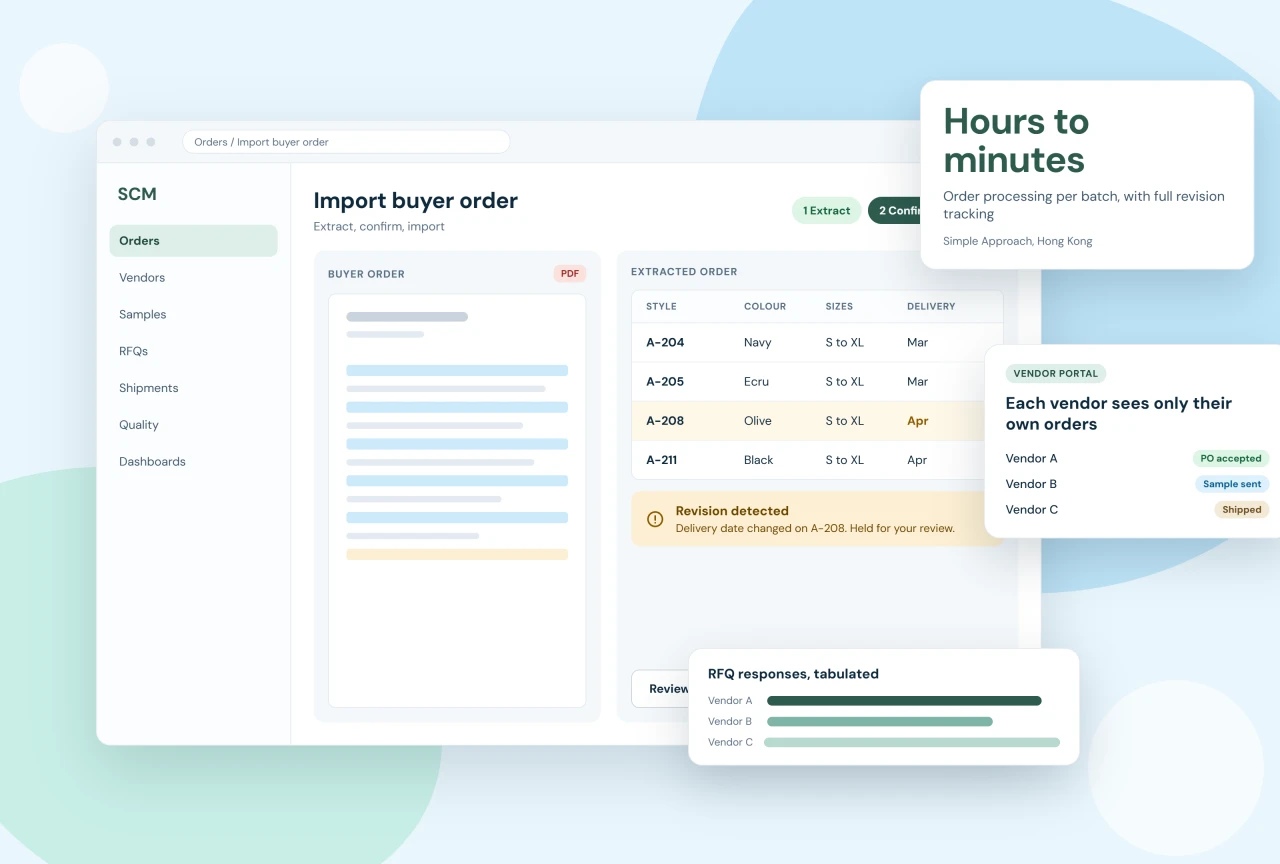
Hours to minutes
Zero manual TnA creation
360° visibility
Five places an order slips, and what Axind does about each
Most founders, heads of sourcing and merchandising leads already know where an order goes wrong between buyer and factory. These are the usual places, and what Axind does about each.
SCM
Buyer orders and techpacks arrive as PDFs and get retyped
Every buyer sends a different format, and revisions arrive highlighted in a PDF that is easy to miss. Retyping introduces errors, and a wrong spec can reach the factory floor before anyone notices.
SCM is the sourcing core: orders, vendors, product data and shipments in one connected system. Its AI tools read the buyer’s document, you confirm it, and the record is created. No retyping, no missed revisions.
The AI-Order-Importer has revolutionized the way we handle order information. It has not only saved us time but also enhanced our productivity and accuracy.
Ravi Jain
What used to take hours now takes minutes, allowing our team to focus on more important tasks.
Laxman Palaniappan
No separate licence or login.
AI-Order-Importer
Reads buyer orders in PDF, Excel and more, and imports them into order management. Revisions are detected and held for your review.
AI-Techpack-Importer
Extracts styles, colourways, size specs, measurements, BOM and fabric details from the buyer’s techpack. Extract, confirm, import.
WebTnA
You find out a factory is behind when it's too late
Delays surface in a status call, after the window to fix them has closed. Your team is on Tuesday’s file and the factory is on the one from three weeks ago.
WebTnA gives every order one live timeline shared by your team and your vendors. It flags delays and their knock-on effects, chases factories before a milestone is missed, and lets you model a change before you commit. With AI-Order-Importer, a buyer PO starts its timeline automatically.
Related reading: Why spreadsheets are the wrong tool for production timelines
Working with Axind AI-Order-Importer and WebTnA has been a game-changer. My team says it is probably one of the best systems they have seen — and they have seen many. We're never going back to our old way of working. This is the future.
Aakash Chugh
Manager, Digital Products — Poeticgem
We have been able to achieve an on-time delivery of 99%. The beauty of this software is its simplicity and easy handling.
AI-Costing
Quoting against a buyer's target price takes too long
Costings are built by hand, factory by factory, and the buyer is waiting. Quotes come back in different formats and have to be compared in a spreadsheet.
AI-Costing produces structured, benchmarked costings from a techpack or product image across multiple sourcing cities, so vendor conversations start from a data-backed number. Inside SCM, RFQ management sends private or public RFQs, tabulates the responses automatically and points to the best quotation.
No separate licence or login.
AI-Costing
Benchmarked costings from a techpack or product image across sourcing cities, before the techpack is finished. Feeds straight into SCM’s supplier engagement and RFQ workflow.
AI-Translator
Buyers and factories each work from a different version
Specs, approvals and documents are scattered across inboxes, in several languages. A factory in Dhaka and a buyer in Hamburg should not need you to relay every change.
SCM gives vendors their own portal with their own purchase orders, shipments and WebTnA timelines. Each vendor sees only their own orders. Specs, approvals and compliance documents are shared in one place with everything on record. AI-Translator translates buyer and supplier messages and documents, so language does not slow the order.
Axind is a holistic solution to an effective order management system and has made data handling very easy and transparent. We have 360-degree visibility on every detail of an article and order — this has helped us tremendously to improve our performance and service to our customers.
Aman Dhaliwal
Head of Product & Design — Techno Design GmbH
No separate licence or login.
AI-Translator
Translates buyer communications, supplier messages and documents across languages, keeping the layout.
SCM
Samples and approvals are hard to track
Sample variants, lab dips, size sets and garment tests are spread across emails and files. Nobody has one view of what is approved and what is still waiting on a vendor.
SCM tracks sample variants across colourways and size breaks from development to approval. Review developments in sequence and approve, reject or comment as you go. Lab dips, size-set approvals and tests are recorded per vendor and production stage, and a sampling dashboard shows conversion rates, cost and delivery performance across the pipeline.
Quality and compliance are part of the same workflow: inspections, defect tracking and vendor scorecards sit next to the orders they relate to, so problems surface before they become shipment delays.
Built to go live fast and to fit how your office already works
Live in weeks instead of months
Configured around your process
Easy for every merchandiser
It's one workflow and all the data is in one spot — every department, every category, doing the work the same way.
Ashesh Amin
Use SCM on its own, or as the sourcing core of a connected platform. Product data and techpacks from PLM+ flow into SCM, and SCM purchase orders and shipments feed WebTnA timelines, with no re-entry between systems.
Common questions
SCM software connects the sourcing process end to end: buyer orders, product data, samples, purchase orders to vendors, shipments, quality and reporting. Axind SCM puts these in one system with one live view across your order book and your vendor base.
Yes. AI-Order-Importer reads buyer orders in PDF, Excel and other formats and AI-Techpack-Importer reads techpacks. You review the extracted data and confirm before anything is created, and revised orders are detected and held for review.
With WebTnA, every order has one live timeline shared by your team and your vendors. It flags delays and their knock-on effects and reminds factories before a milestone is missed.
Yes. SCM’s RFQ management sends private or public RFQs, tabulates the responses automatically and points to the best quotation. AI-Costing gives you a benchmarked starting number before you go to vendors.
No. Each vendor sees only their own purchase orders, shipments and timelines in their portal.
Typically in weeks instead of months. The exact timeline depends on how much data you bring across and how you want the system configured.