

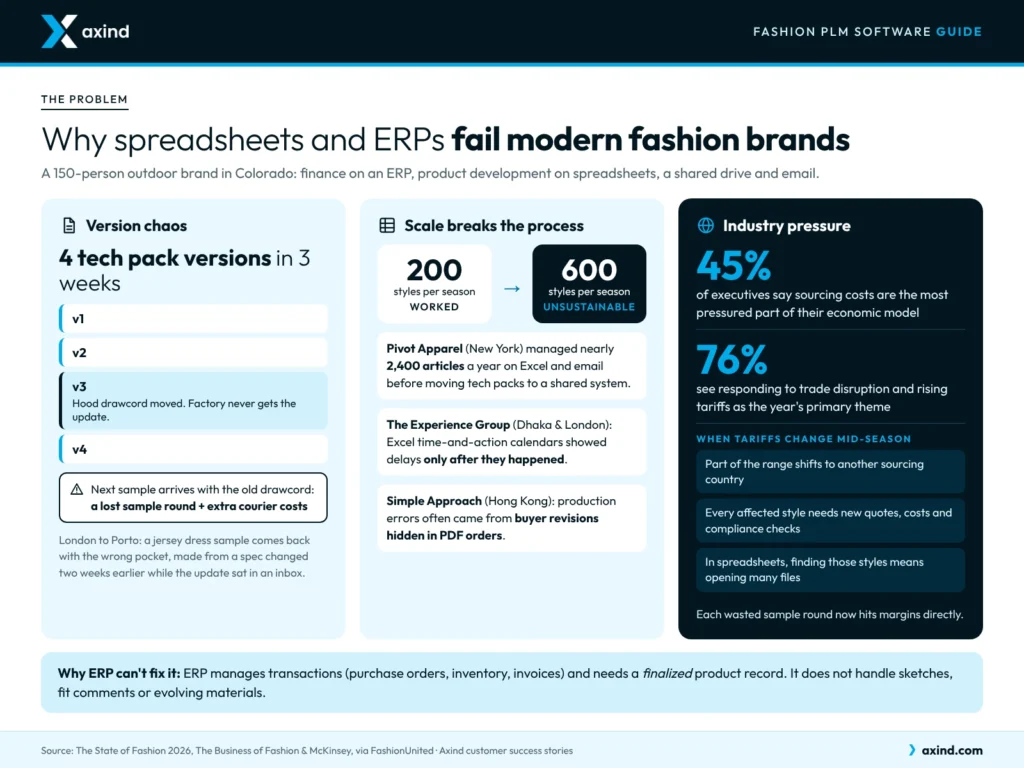
At 9 a.m. in London, a technical designer at a womenswear brand reviews a factory photo from Porto and finds the wrong pocket on a jersey dress. The factory used an outdated specification that had changed two weeks prior, while the updated file remained in an inbox.
Fashion PLM software is an enterprise system for apparel, footwear, and home decor brands to centralize product data from concept to production in a single shared record. This ensures all teams and suppliers work from the same version.
Mistakes like the one in Porto are increasingly costly. According to The State of Fashion 2026 by The Business of Fashion and McKinsey, 45% of executives identify sourcing costs as the most pressured part of their economic model, FashionUnited reports. Each wasted sample round now directly affects margins.
Suppliers encounter similar issues. The Hong Kong buying agent Simple Approach found that production errors often result from buyer revisions hidden in PDF orders. This challenge affects brands selling in the UK, EU, and US.
This guide explains apparel product lifecycle management through real scenarios brands in the US, UK, and Europe face. It covers how styles progress through PLM, the limitations of spreadsheets, key features, market-specific compliance, and ROI measurement.
What is Fashion PLM Software?
Fashion Product Lifecycle Management (PLM) software is an enterprise system for apparel, footwear, and home decor brands. It centralizes product data from concept, sketching, and tech pack development through sourcing, costing, sampling, and production. This gives design, merchandising, sourcing, and supplier teams a single source of truth instead of scattered spreadsheets.
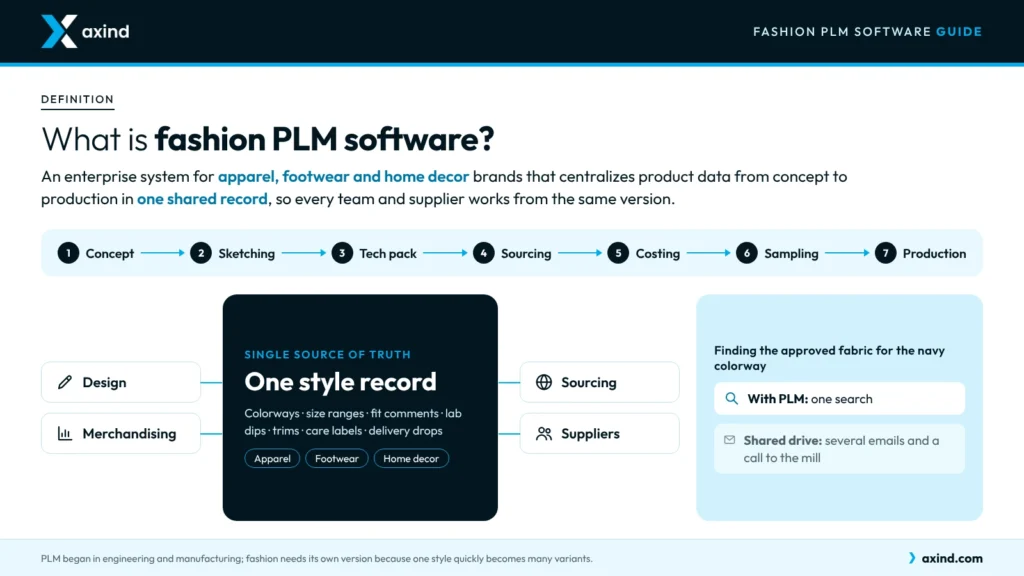
The difference is obvious in daily tasks. In fashion PLM software, identifying the approved fabric for the navy colorway requires only one search. On a shared network, it may take several emails and a call to the mill.
How Apparel Product Lifecycle Management Works: One Jacket, Three Markets
Apparel product lifecycle management is easiest to understand by following a single product. Consider a recycled-polyester puffer jacket designed in Amsterdam, manufactured in Vietnam, and sold in the US, UK, and EU:
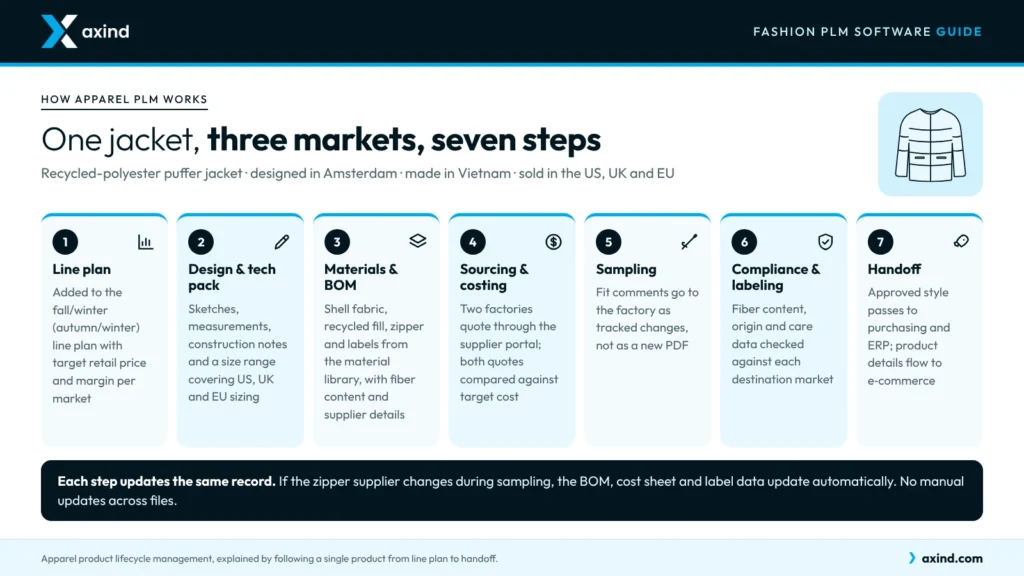
- Line plan: The merchandiser adds the jacket to the fall/winter (autumn/winter) line plan with a target retail price and margin for each market.
- Design and tech pack: The designer uploads sketches. The technical designer adds measurements, construction notes and a size range that covers US, UK and EU sizing.
- Materials and BOM:The shell fabric, recycled fill, zipper and labels come from the material library, each with fiber content and supplier details attached.
- Sourcing and costing: Two factories quote through the supplier portal, and the team compares both quotes against the target cost.
- Sampling: Fit comments from the first sample go to the factory as tracked changes, not as a new PDF.
- Compliance and labeling: Fiber content, origin and care data are checked against the rules of each destination market.
- Handoff: The approved style passes to purchasing and ERP, and product details flow to e-commerce. Each step updates the same record. If the zipper supplier changes during sampling, the BOM, cost sheet, and label data update automatically, eliminating the need to update multiple files manually.
Why Traditional ERPs and Spreadsheets Fail Modern Fashion Brands?
The Bottlenecks of Fragmented Tech Packs and Manual Version Control
Growing brands encounter this challenge at a predictable stage. New York-based Pivot Apparel managed nearly 2,400 articles annually using Excel and email before transitioning its tech packs to a shared system.
ERP systems cannot prevent these issues. They are designed to manage transactions such as purchase orders, inventory, and invoices, and require a finalized product record. As a result, they do not accommodate sketches, fit comments, or evolving materials.
Managing Seasonal Velocity and Compressed Design Calendars
Production calendars encounter similar issues. The Experience Group, with offices in Dhaka and London, found that its Excel time-and-action calendars revealed delays only after they occurred. Transitioning to a live system increased its on-time delivery rate to a reported 99%.
This scenario is now widespread in the industry. FashionUnited reports that 76% of executives surveyed for The State of Fashion 2026 identify responding to trade disruption and rising tariffs as the year’s primary theme.
Core Capabilities of Top-Tier Apparel PLM Systems
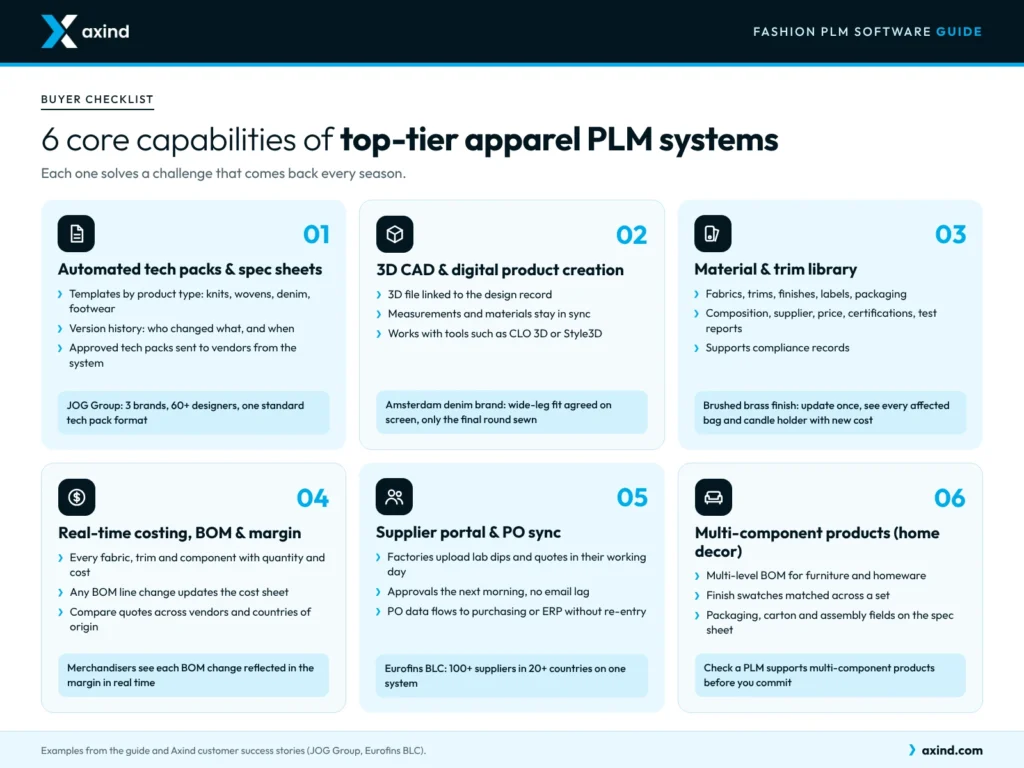
Automated Tech Pack Generation & Spec Sheet Management
JOG Group in the Netherlands runs three brands, Jeans Centre, Garcia and CHASIN’, with more than 60 designers. Each brand team once used its own tech pack format, which confused shared suppliers. After bringing all three brands onto Axind PLM+, the group works from one standardized tech pack format, according to its success story.
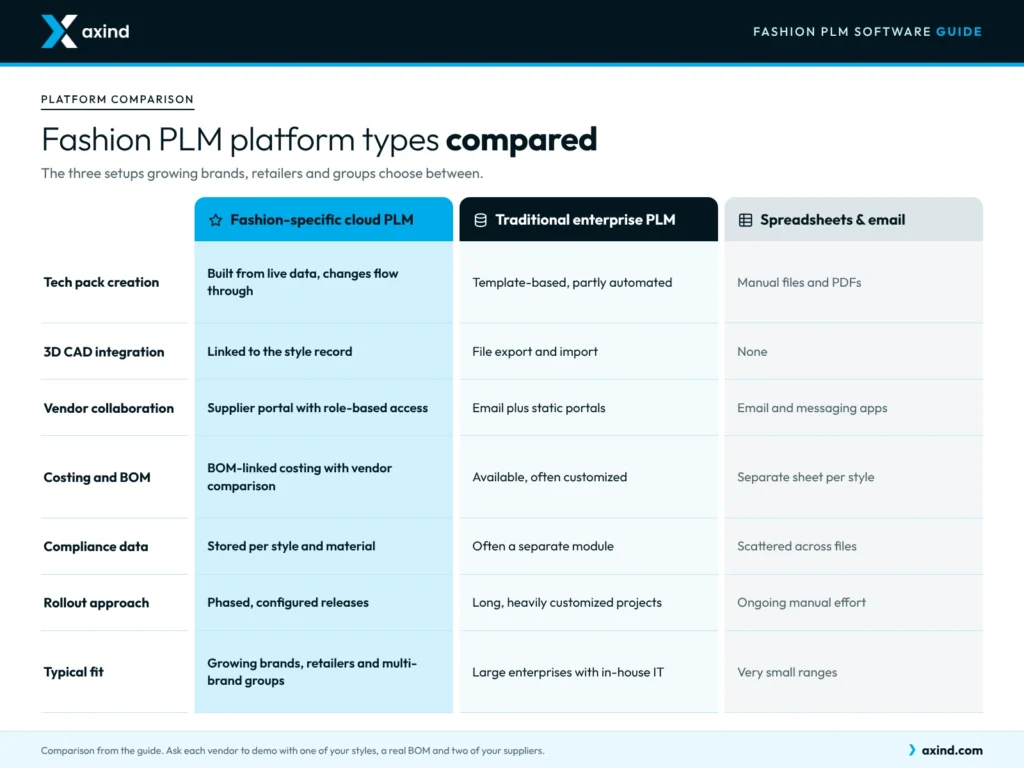
This is the primary function of fashion tech pack software within a PLM. Tech packs are created from structured fields rather than static documents, so a single measurement change updates all relevant views. Buyers should look for:
- Templates by product type: Knits, wovens, denim and footwear each need different spec fields.
- Version history:Every change is logged with who made it and when.
- Supplier distribution: Approved tech packs go to vendors from the system, not as email attachments.
3D CAD & Digital Product Creation (DPC) Integration
These savings are realized only when the 3D file is linked to the design record in PLM. Once linked, measurements and materials stay synchronised. Without this connection, the team must manually export files and verify versions.
Material & Trim Library Management (Digital Fabric Swatches)
A lifestyle brand uses the same brushed brass finish for both handbag hardware and a line of candle holders. When the plating supplier raises prices, the buyer updates the finish record once in the material library and immediately sees every affected product with the new cost.
A material library stores fabrics, trims, finishes, labels, and packaging along with composition, supplier, price, certifications, and test reports. Designers select from approved materials each season, and these records also support compliance requirements.
Real-time Costing, Bill of Materials (BOM) and Margin Tracking
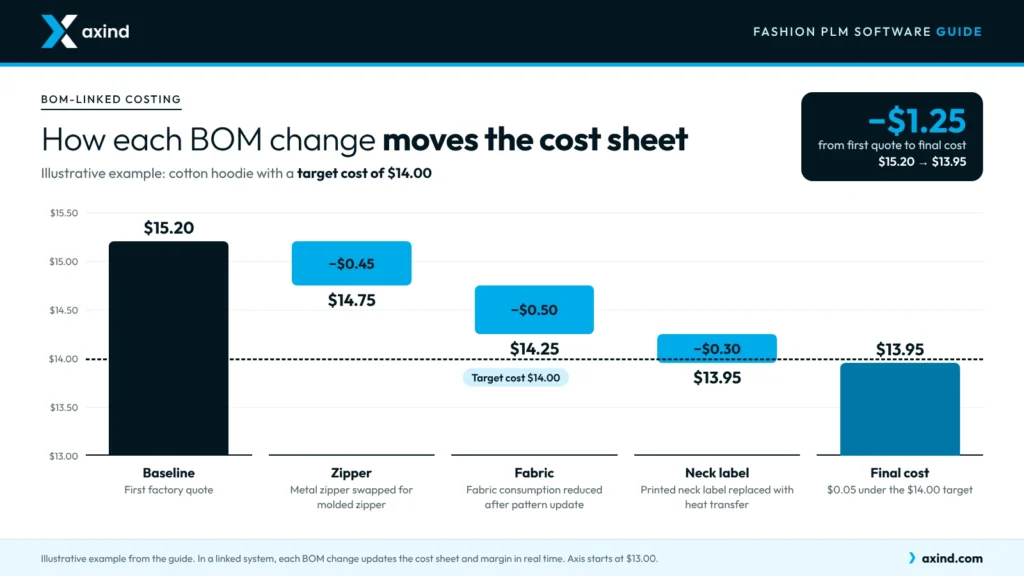
A bill of materials (BOM) lists every fabric, trim, and component in a style, including quantities and costs. When costing is linked to the BOM, any line change updates the entire cost sheet.
Here is an illustrative example for a cotton hoodie with a target cost of $14.00:
Supplier Portal & Purchase Order (PO) Synchronization
A UK retailer works with a sourcing office in Dhaka, with limited overlapping working hours. Using a supplier portal, the factory uploads lab dip photos and quotes during its day. The London team reviews and approves them the next morning, promising no delays in communication.
The same approach works at a much larger scale. Eurofins BLC manages more than 100 suppliers across 20+ countries on one system, with each supplier updating its own activities inside the workflow.
Brands that manage vendor bids, sample rounds, and landed costs in one system usually extend PLM with integrated fashion sourcing. Once a style is approved, PO data transfers to purchasing or ERP without manual re-entry.
When the Range Includes Home Decor
Many fashion brands and retailers also sell homeware, and those products bring different data. Take an oak side table added to a lifestyle brand’s home range. Its BOM has several parts: a solid oak top, a composite wood drawer, a hardware pack and an assembly sheet. Its finish must match the rest of the set it is sold with.
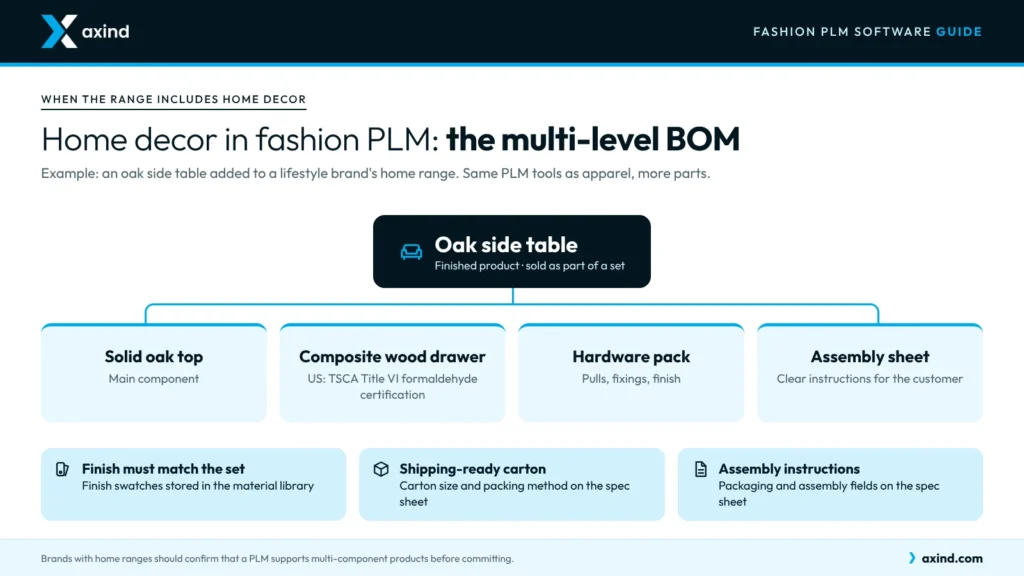
The factory also requires a shipping-ready carton size and packing method, and the customer needs clear assembly instructions. PLM software manages this using the same tools as for apparel: a multi-level BOM, finish swatches in the material library, and packaging and assembly fields on the spec sheet. Brands with home ranges should confirm that a PLM supports multi-component products before committing.
How Fashion PLM Supports US, UK and EU Compliance
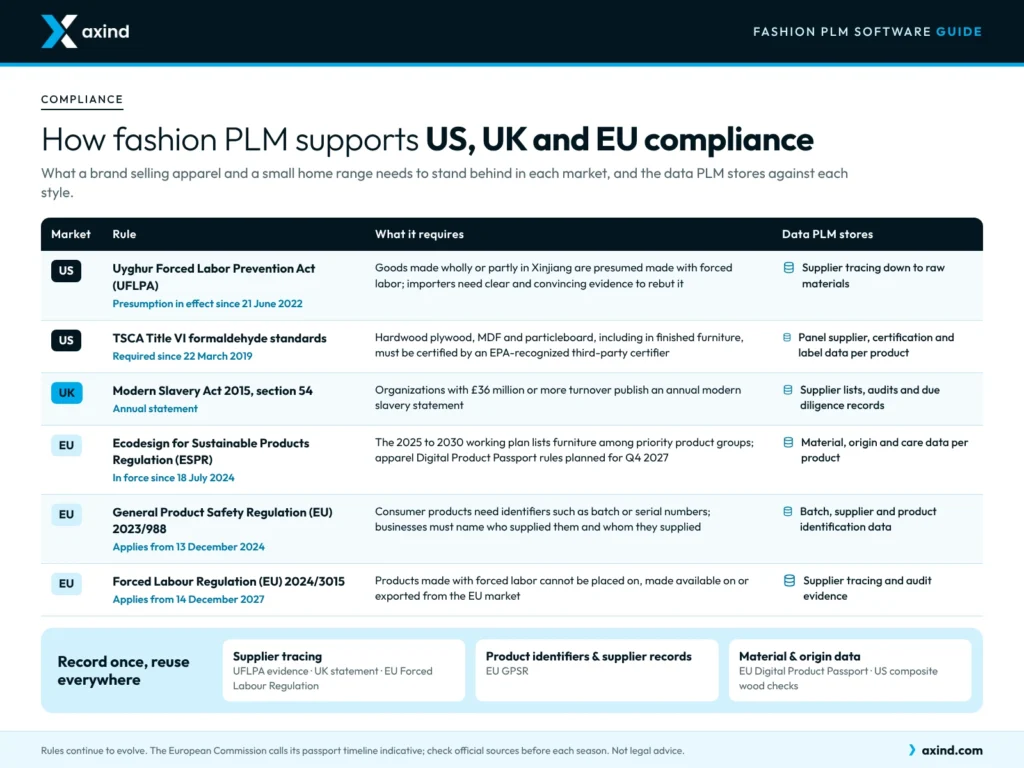
The overlap is highly valuable. Supplier tracing supports UFLPA evidence, the UK statement, and the EU Forced Labour Regulation. Product identifiers and supplier records fulfill GPSR requirements, while material and origin data support the EU passport and US composite wood checks. Recording this information once per product in PLM eliminates redundant evidence gathering.
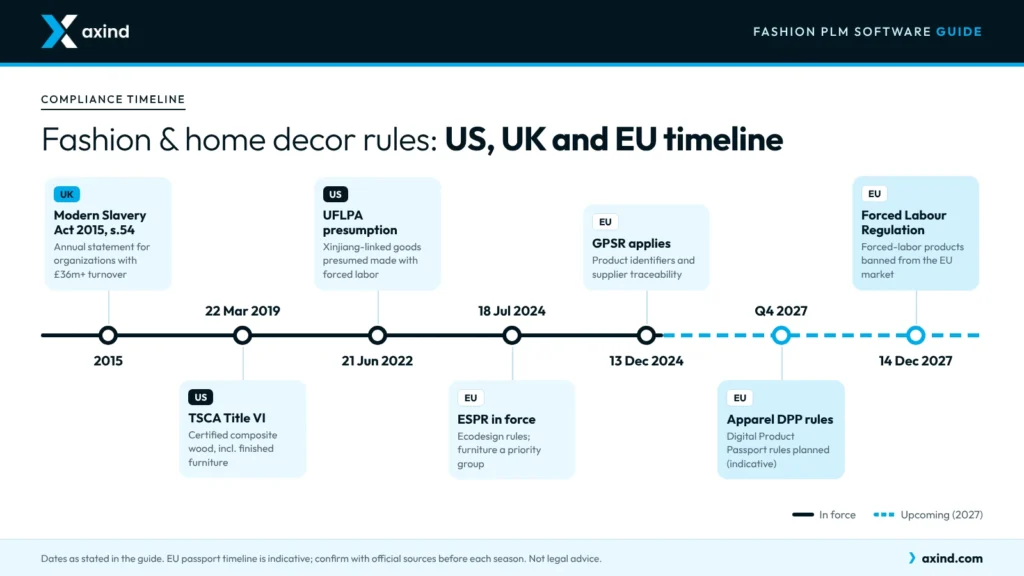
These regulations continue to evolve. The European Commission describes its passport timeline as indicative, so compliance teams should consult official sources before each season.
Best PLM for Fashion: Which Platform Type Fits Which Brand?
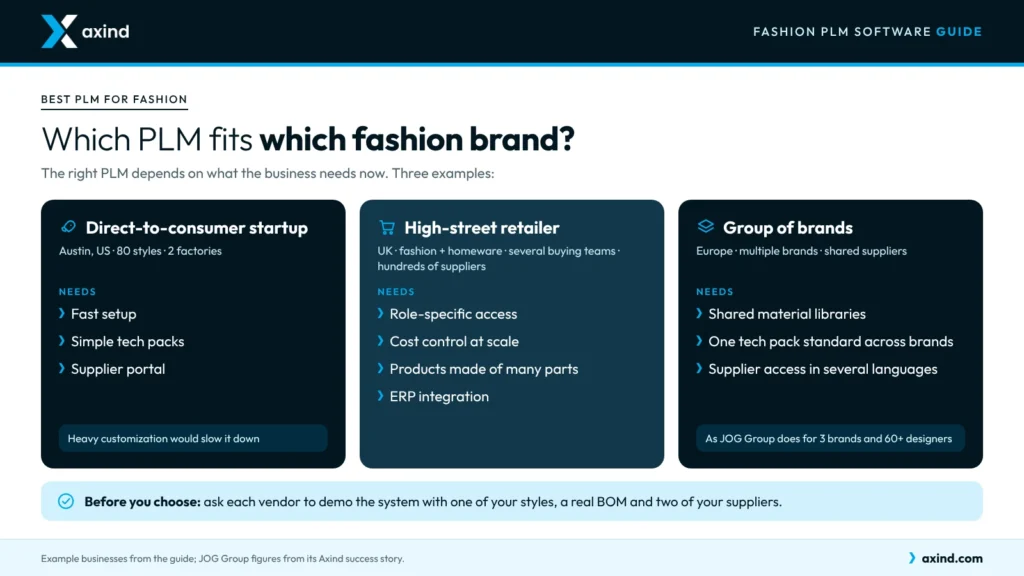
The most suitable PLM for fashion depends on a brand’s current needs. The following three businesses illustrate how requirements vary:
The most suitable PLM for fashion depends on a brand’s current needs. The following three businesses illustrate how requirements vary:
- A direct-to-consumer startup in Austin with 80 styles and two factories needs fast setup, simple tech packs and a supplier portal. Heavy customization would slow it down.
- A UK high-street retailer selling fashion and homeware, with several buying teams and hundreds of suppliers, needs role-specific access, cost control at scale, support for products made of many parts, and ERP integration.
- A European group of brands needs shared material libraries and one tech pack standard across brands, plus supplier access in several languages, as JOG Group does for three brands and 60+ designers.
Evaluating ROI: How Fashion PLM Pays for Itself
Direct Cost Reductions (Sample Revisions, Shipping Costs, Fabric Waste)
A basic sampling model requires four figures from the previous season: styles developed, sample rounds per style, cost per round (including materials, production, and courier), and the proportion of rounds caused by incorrect or outdated specifications.
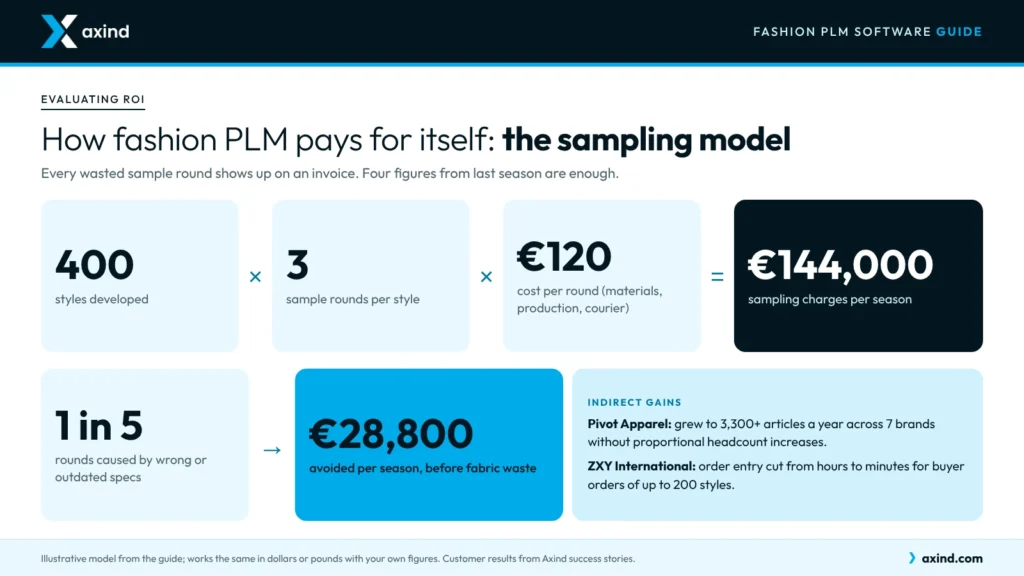
For example, a brand develops 400 styles with three sample rounds each at €120 per round, totaling €144,000 in sampling charges. If one in five rounds results from specification errors, the company avoids about €28,800 per season, excluding fabric waste. This model applies equally in dollars or pounds using actual financial data.
Indirect Productivity Gains (Merchandiser and Designer Manual Labor Savings)
New York-based Pivot Apparel started with Excel for tech packs, email threads for sampling and manual buyer presentations. After moving to Axind PLM+, it grew to more than 3,300 articles a year across seven brands without proportional headcount increases, according to its success story.
The primary benefit is time returned to product development. Designers no longer rebuild line sheets, and merchandisers avoid repeatedly requesting supplier status updates.
Order handling demonstrates similar improvements. ZXY International reduced order entry time from hours to minutes for buyer orders containing up to 200 styles each.
Implementation and Rollout Expectations
Fashion PLM ROI begins once the system is live, making rollout speed important. A typical phased plan includes scoping, data cleanup, configuration and integration, a pilot for one category, and a wider rollout with supplier onboarding.
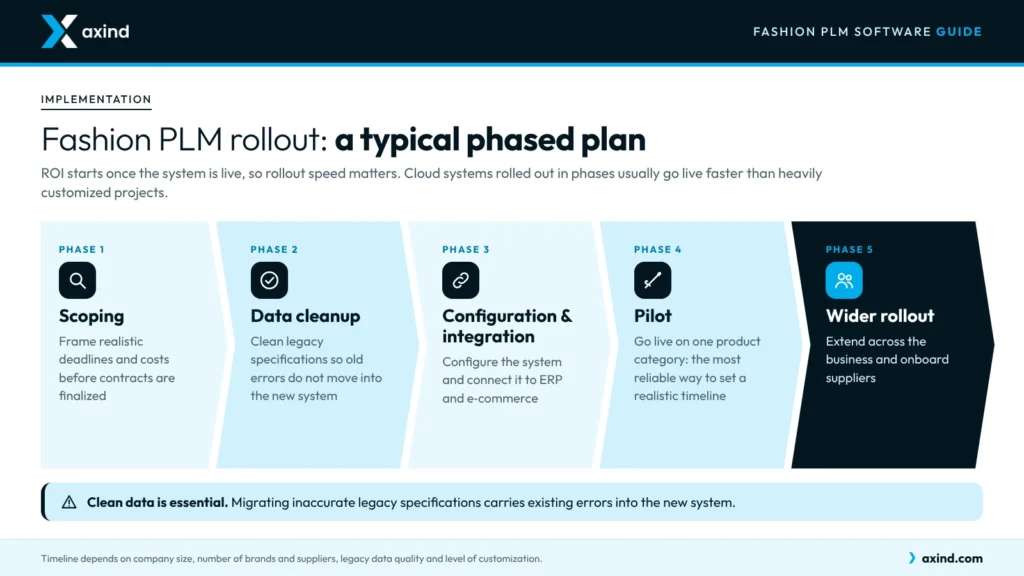
A detailed PLM implementation roadmap helps frame realistic deadlines and expenses before contracts are finalized.
Integrating PLM into Your Retail Tech Stack
Consider a swimwear style on the day it is approved. Within hours, its PLM data must reach several other systems, and each manual transfer introduces the risk of error.
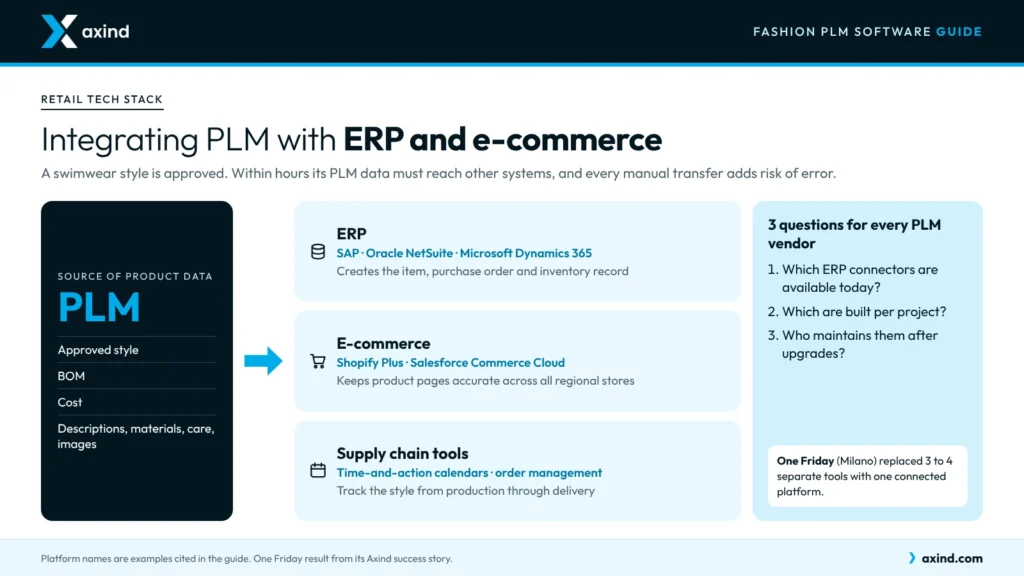
Connecting PLM with ERP (SAP, NetSuite, Microsoft Dynamics)
Buyers should ask each PLM vendor three questions: which ERP connectors are currently available, which are developed per project, and who is responsible for maintenance after upgrades.
Synchronizing with E-Commerce Platforms (Shopify Plus, Salesforce Commerce Cloud)
Next, product details are sent to e-commerce platforms. Descriptions, materials, care instructions, and images often originate in PLM, so transferring them to Shopify Plus or Salesforce Commerce Cloud ensures product pages remain accurate across all regional stores.
Children’s fashion brand One Friday, with a design studio in Milano, consolidated three to four separate tools into one connected platform. Product development, manufacturing timelines, and a unified catalogue for retail, wholesale, and e-commerce now operate within a single system.
Broader apparel supply chain software utilizes the same record. Time-and-action calendars and order management tools use style and PO data to track the swimsuit from production through delivery.
Bring Design, Sourcing & Production Together with Axind PLM+
Axind reports working with 100+ fashion teams in 20+ countries, supporting supply chains across Asia, Europe, and North America. AI-Translator translates tech pack comments and supplier notes within PLM+, while AI-Costing generates costings across sourcing cities from a tech pack or product image. PLM+ also integrates with Axind SCM for orders and vendors, and with Axind WebTnA for production timeframes.
The Experience Group, which works from Dhaka and London, reports 99% on-time delivery with Axind WebTnA, according to its success story.
With Axind PLM+, fashion teams benefit from:
- One style record: Styles, samples, revisions and approvals sit in a single place.
- Linked costing: BOM-linked costing with vendor and country-of-origin comparison.
- Supplier collaboration: RFQ management, capacity tracking and shared development with vendors.
Discover how Axind PLM+ helps fashion brands and sourcing teams in the US, UK, and Europe move from spreadsheets to a unified product record.
Book a Free Demo
Fashion PLM Software FAQs
What is fashion PLM software?
Fashion PLM software is an enterprise system built for apparel, footwear, and home decor brands that centralizes product data from concept, sketching, and tech pack development through sourcing, costing, sampling, and production. Fashion PLM software gives design, merchandising, sourcing and supplier teams a single source of truth instead of scattered spreadsheets.
What is the difference between ERP and PLM in fashion?
PLM manages a product’s creative and technical development, from concept and design to tech packs, BOMs, and vendor approval. ERP manages transactional execution, including inventory, purchase orders, financial accounting and order fulfillment. In fashion, PLM creates the approved product data and ERP uses that data to run the physical and financial side of the business. supplier teams a single source of truth instead of scattered spreadsheets.
How long does it take to implement a fashion PLM system?
Fashion PLM implementation time depends on company size, the number of brands and suppliers, the quality of legacy data and the level of customization. Cloud-based systems rolled out in phases usually go live faster than heavily customized legacy projects. A pilot on one product category is the most reliable way to define a realistic timeline for the full rollout.
What is fashion tech pack software?
Fashion tech pack software creates and manages the technical specification documents that factories use to make a garment. A tech pack includes sketches, measurements, construction details, materials, trims, artwork and labeling. When tech pack software sits inside a PLM, specs are built from live product data, so suppliers always receive the latest approved version.
Is fashion PLM software only for large enterprises?
Fashion PLM software is not limited to large enterprises. Growing brands, sourcing offices, and multi-brand groups use cloud-based PLM systems. The right time to adopt PLM is usually when the number of styles, suppliers or team members makes spreadsheets and email hard to control, not when a brand reaches a specific revenue size.
How does fashion PLM software help with US, UK and EU compliance?
Fashion PLM software helps with compliance by storing supplier tracing, material, origin and test data against each product. US importers can use it to support UFLPA evidence, and brands with home ranges can track composite wood certification. UK companies can use it for Modern Slavery Act statements, and EU brands for GPSR records and future passport data.