

What Is Fashion PLM Implementation?
|
Workstream
|
What it covers
|
Who leads it
|
|---|---|---|
|
Process
|
Current and future workflows, approval gates, calendar milestones
|
Department leads
|
|
Data
|
Styles, BOMs, fabric and trim libraries, size charts, supplier records
|
Product data owner
|
|
Technology
|
Configuration, ERP and design tool integrations, user roles
|
IT or integration lead
|
|
People
|
Training, super-users, adoption tracking
|
Project manager and HR
|
|
Suppliers
|
Portal access, tech pack delivery, supplier training
|
Sourcing lead
|
Scope drives timing. According to Johnson & Wales University, mid-market cloud PLM projects usually take weeks, while enterprise suites often take six months to more than a year to implement.
Why Your PLM Deployment Strategy Decides the Outcome
- A PLM deployment strategy is the plan that locks in scope, sequence, owners, and success measures before anyone configures a single screen. When a fashion PLM project stalls, the software is not often the main cause. The usual reasons are unclear scope, messy data and teams that keep working the old way. Two research findings show where the risk sits:
- People: Prosci found that 88% of projects with excellent change management met or exceeded their objectives. Those projects were about seven times more likely to meet objectives than projects with poor change management.
- Data: Gartner estimates that poor data quality costs organizations at least US$12.9 million a year on average, based on its 2020 research. Gartner also reports that 59% of organizations do not measure data quality.
For a fashion brand, both risks show up in the same place: the tech pack. A designer updates a measurement in one file. The factory receives an older version. The fit sample comes back wrong, and a two-week sample round is lost. Growth makes this worse. Pivot Apparel, a New York sourcing company with its own brands and an in-house design team, ran on Excel, email and manual coordination after its 2020 launch. By 2023, it handled nearly 2,400 articles a year, and tech pack inconsistencies caused costly production errors. After moving to our PLM, its Design, Product Development, Technical Design and Sales teams now work within connected processes. CEO and COO Ashesh Amin sums up the goal as “one workflow and all the data in one spot.” The roadmap below turns that goal into five phases.
The 5-Phase Fashion PLM Implementation Roadmap
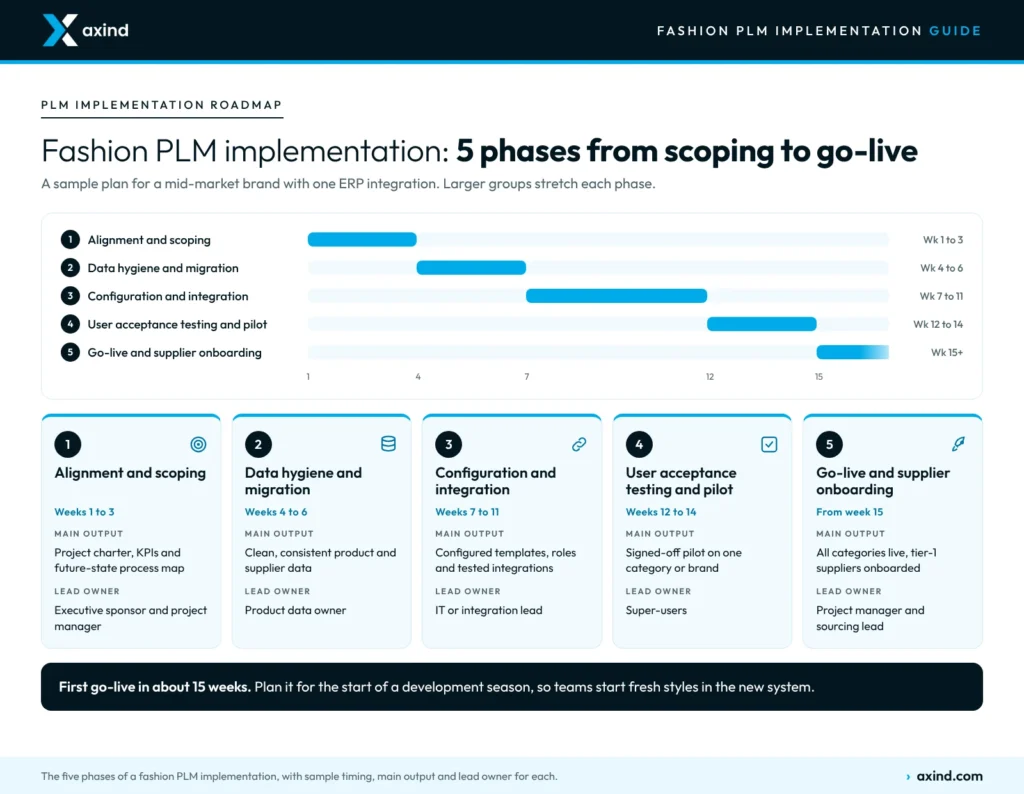
A fashion PLM implementation moves through five phases: alignment and scoping, data hygiene and migration, system configuration and integration, user acceptance testing and pilot, then go-live with supplier onboarding. The week ranges below are a sample plan for a mid-market brand with one ERP integration. Larger groups stretch each phase.
|
Phase
|
Sample timing
|
Main output
|
Lead owner
|
|---|---|---|---|
|
1. Alignment and scoping
|
Weeks 1 to 3
|
Project charter, KPIs, future-state process map
|
Executive sponsor and project manager
|
|
2. Data hygiene and migration
|
Weeks 4 to 6
|
Clean, consistent product and supplier data
|
Product data owner
|
|
3. Configuration and integration
|
Weeks 7 to 11
|
Configured templates, roles and tested integrations
|
IT or integration lead
|
|
4. User acceptance testing and pilot
|
Weeks 12 to 14
|
Signed-off pilot on one category or brand
|
Super-users
|
|
5. Go-live and supplier onboarding
|
From week 15
|
All categories live, tier-1 suppliers onboarded
|
Project manager and sourcing lead
|
Phase 1: Alignment and Scoping (Weeks 1 to 3)
- Sample rounds per style: How many proto, fit and pre-production samples each style needs before approval.
- Tech pack error rate: How often a factory query or wrong sample traces back to a tech pack mistake.
- Approval turnaround: Days from a submitted sample or cost to a decision.
- Calendar adherence: Share of time-and-action (T&A) milestones closed on time.
Phase 2: Data Hygiene and Migration Strategy (Weeks 4 to 6)
Data hygiene determines whether the new PLM starts with trusted data or old problems in a new home. Teams clean legacy spec sheets, fabric and trim libraries, supplier records and historical BOMs before anything is imported.
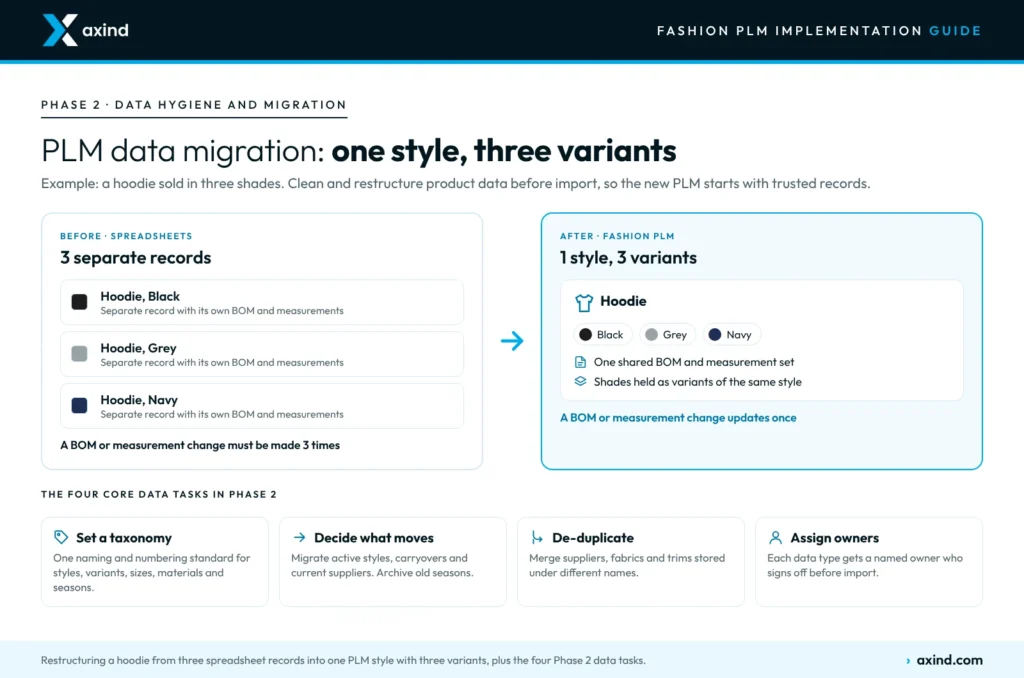
The core tasks are:
- Set a taxonomy: Agree on one naming and numbering standard for styles, variants, sizes, materials and seasons.
- Decide what moves: Migrate active styles, carryovers and current supplier data. Archive old seasons instead of importing them.
- De-duplicate: Merge repeated suppliers, fabrics and trims that exist under different names.
- Assign owners: Give each data type a named owner who signs off before import.
A simple scenario shows why this matters. A hoodie sold in three shades is often stored as three separate records in data sheets. In a clearly structured PLM, it becomes one style with three variants, so a change to the BOM or measurements updates once. Eurofins BLC, the textile testing and certification division of Eurofins Scientific, faced this exact issue. Its earlier setup held three separate files per product for product data, workflow steps and comments. T&A calendars were created per variant, so a product in three shades meant three calendars tracking the same activities. During the move, products were rebuilt as single entries with all variants consolidated, and the old workflow data was mapped to product-level T&A calendars.
Phase 3: System Configuration and Integration (Weeks 7 to 11)
- Tech pack templates: Standard layouts that auto-fill for new styles.
- Approval gates: Who signs off on design, fit, cost and lab dips, and in what order.
- User roles and permissions: What each team and each supplier can see and edit.
- Integrations: ERP for purchase orders and costs, design tools such as Adobe Illustrator and 3D tools such as CLO 3D or Style3D where the PLM supports them, plus e-commerce or retail systems.
Integration can also simplify the stack. One Friday, a high-end childrenswear brand with a design studio in Milan, stores across India, wholesale accounts and an e-commerce business, ran on legacy client-server ERP systems that needed constant maintenance. Excel filled the gaps. One Friday moved onto three of our cloud products: Axind PLM+ for product development, OMNI for catalogue and inventory, and WebTnA for manufacturing timelines, with native integration to its own website and major e-commerce platforms. CEO Meet Sawhney notes that the alternative would have been integrating three or four different tools.
Phase 4: User Acceptance Testing (UAT) and Pilot (Weeks 12 to 14)
User acceptance testing (UAT) and a pilot prove the configured PLM works for real people on real styles before the full rollout. The best pilots run one product category or one brand through a live development cycle.
Write test scripts around handoffs, because handoffs are where work breaks:
- A designer creates a style, adds a sketch and builds the BOM.
- A technical designer adds measurements and construction details.
- A merchandiser reviews costs and approves the design.
- The supplier receives the tech pack and returns a quote.
- The fit sample is reviewed, commented on and approved in the system.
Pivot Apparel’s setup shows why role handoffs deserve this attention. Design, Product Development, Technical Design and Sales each work in role-based workflows, and suppliers now join the live workflow instead of waiting on email chains.
Set specific exit criteria before the pilot starts: critical issues closed, super-users signed off, and baseline KPIs captured for later comparison.
Phase 5: Go-Live, Vendor Onboarding and Continuous Improvement (From Week 15)
Go-live extends the PLM from the pilot to every category and brings suppliers into the system. Most brands roll out in waves by category or brand rather than switching everything on in one day.
Vendor onboarding is often the hardest part. Tier-1 suppliers need simple access, training in their own language and a clear reason to use the portal instead of email. Eurofins BLC now runs more than 100 suppliers across over 20 countries in one connected system, and suppliers add their own articles directly.
Scale works when the structure is right. Our customer GruppoCoin in Italy runs more than 200 users across six buying offices in five countries on one PLM.
Continuous improvement starts after go-live. Review KPIs each season, retire workarounds and add modules only when the core workflow is stable. Live dashboards help here. Before The Experience Group, an apparel manufacturer with offices in Dhaka and London, moved off Excel T&A calendars, managers had to keep asking teams for status and saw delays only after they happened. With live dashboards for the whole merchandising team, the company reports 99% on-time delivery.
Apparel PLM Project Management: Who Owns Each Phase
Apparel PLM project management works best when every phase has a named owner and a small core team meets weekly. A typical structure looks like this:
|
Role
|
Main responsibility
|
Most active in
|
|---|---|---|
|
Executive sponsor
|
Secures budget, settles scope disputes, removes blockers
|
Phases 1 and 5
|
|
Project manager
|
Runs the plan, risks, weekly status and vendor coordination
|
All phases
|
|
Department leads
|
Approve future-state workflows for design, merchandising, sourcing and technical design
|
Phases 1 and 3
|
|
Super-users
|
Test early, train peers and collect feedback
|
Phases 3 to 5
|
|
Product data owner
|
Cleans, aligns and signs off data before import
|
Phase 2
|
|
IT or integration lead
|
Builds and tests ERP, design tool and e-commerce links
|
Phase 3
|
|
Supplier champions
|
Bring key factories onto the portal and handle their questions
|
Phase 5
|
How Long Does Fashion PLM Implementation Take?
A fashion PLM implementation usually takes weeks for a mid-market brand on cloud software, and six months to more than a year for an enterprise suite. The sample plan in this guide reaches its first go-live in about 15 weeks. The timeline depends on the number of users, categories and integrations, and on how much legacy data needs cleaning first.
Johnson & Wales University describes mid-market cloud PLM as typically implemented in weeks, compared with six months to over a year for enterprise platforms. At Axind, most of our customer teams are fully operational within weeks, not months.
These factors move the timeline most:
|
Factor
|
Shortens the timeline
|
Lengthens the timeline
|
|---|---|---|
|
Deployment model
|
Cloud SaaS with standard templates
|
On-premises install or heavy custom code
|
|
Data condition
|
One clean style master and supplier list
|
Years of spreadsheets with duplicate records
|
|
Integrations
|
One ERP link, designed and tested early
|
Several systems, or integration left until go-live
|
|
Scope
|
One brand or category first, then waves
|
Every brand and category on day one
|
|
Decision speed
|
One sponsor with authority to settle scope
|
Approval by committee for every change
|
|
Supplier readiness
|
Tier-1 suppliers briefed during Phase 1
|
Suppliers told only at go-live
|
A practical rule: plan the first go-live for the start of a development season, not the middle of one. Teams adopt new workflows faster when they start fresh styles in the new system than when they move half-finished ones.
Top Fashion PLM Implementation Pitfalls and How to Avoid Them
The most common fashion PLM implementation pitfalls are low designer adoption, messy data migration, scope creep, supplier resistance, and late ERP integration. Each one has a known cause and a known fix:
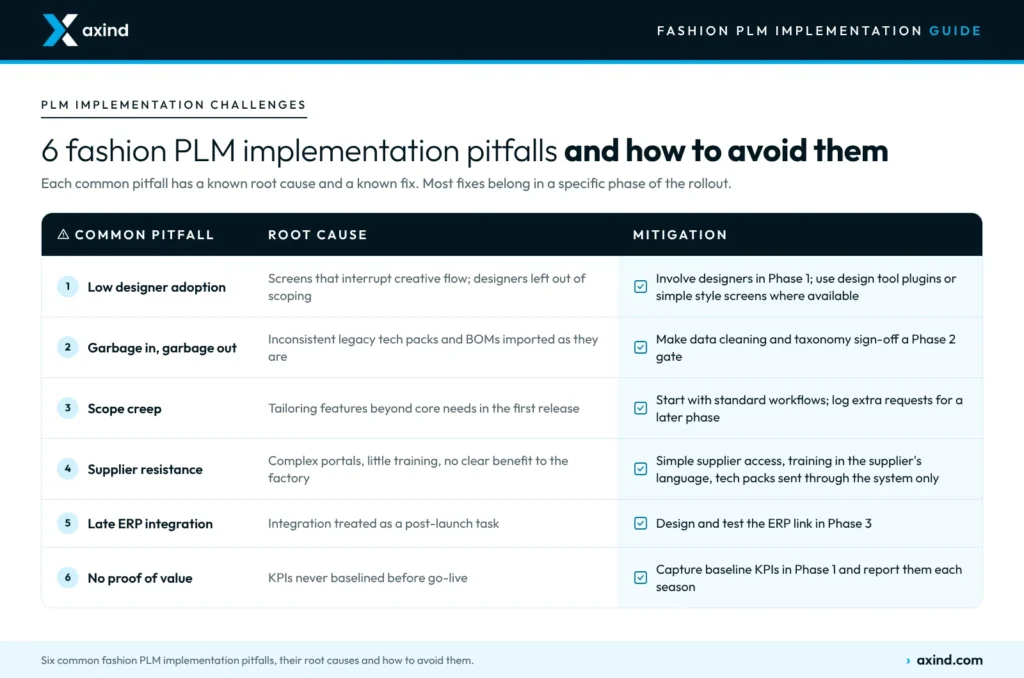
Two of these pitfalls deserve a closer look.
Multi-team standards: When several design teams each keep their own tech pack format, suppliers receive mixed instructions. JOG Group’s fix was one standard tech pack format across all three brands, with the system configured around each brand’s workflow. New designers now join a documented, consistent process instead of learning each team’s habits.
Language barriers: A factory that cannot read comments in the brand’s language will go back to email and phone calls. Built-in translation inside the PLM, or at least supplier training in the local language, keeps factories working in the system. Our AI-Translator works inside Axind PLM+ for teams that work across languages.
Change Management for a Fashion PLM Rollout
The payoff is measurable. Prosci’s research shows that projects with excellent change management are nearly five times more likely to finish on or ahead of schedule than those with poor change management. They are also nearly 1.5 times more likely to stay on or under budget.
The need is growing as new tools arrive faster. The same Deloitte outlook reports that 68% of surveyed retail executives expect to adopt agentic AI in the next 12 to 24 months. Each new capability depends on teams that already trust and use their core systems, PLM included.
A practical change plan for a fashion PLM rollout follows six steps:
- Explain the why for each role: Designers care about fewer re-sent tech packs. Merchandisers care about live cost and status. Suppliers care about clear, current instructions.
- Appoint super-users in every department: Give them early access and time in their week to help peers.
- Train on real styles: Role-based sessions using the team’s own upcoming styles land better than generic demos.
- Train suppliers in their own language: Short sessions on how to view tech packs, comment and upload samples.
- Retire the old tools on a fixed date: Once tech packs go out only through the PLM, the shared storage stops being the backup.
- Measure adoption weekly: Track logins, styles created and approvals completed in the system during the first season.
Training and support carry real weight in long-term adoption. After 13 years with Axind, JOG Group’s Head of Buying and Product Development Marleen van der Leij-Koops still points to how easy the software is to use and how quickly issues get resolved. At The Experience Group, the merchandising team now manages timelines in one system, and Division Head of Merchandising Khalid Shams Chowdhury credits the software’s simplicity and ease of use.
Fashion PLM Software Cost: A Budgeting Framework
Fashion PLM software cost has three parts: the software subscription or licensing fee, implementation services and internal team time. Johnson & Wales University, citing The Retail Exec, puts mid-market cloud PLM at about $80 to $150 per user per month, with implementation and training costs added on top.
Enterprise suites sit higher. The same article notes that enterprise licensing fees commonly reach five or six figures in US dollars a year, and cites The Retail Exec, which says implementation alone can run into the millions of dollars for large companies. Many vendors quote individually, so these ranges are a planning guide, not a price list.
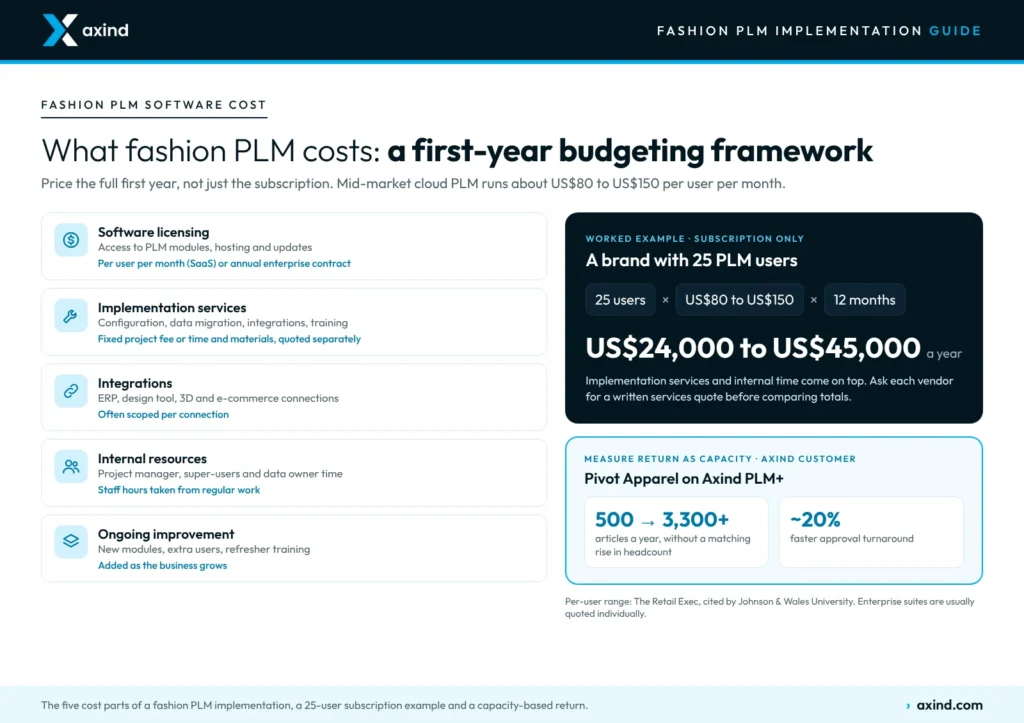
The return comes from capacity, not just savings. Our customer Pivot Apparel grew its article volume from 500 to more than 3,300 a year without a matching rise in headcount, and saw about 20% faster approval turnaround. That is the number to model: how many more styles the current team can develop each season without new hires. Three budgeting tips keep costs predictable:
- Price the full first year: Add subscription, services, integrations and internal time before comparing vendors.
- Phase the scope: Fund the core workflow first and add modules once adoption is proven.
- Protect team time: Budget for super-users to spend part of their week on the project, or the timeline slips.
Fashion PLM Implementation Readiness Checklist
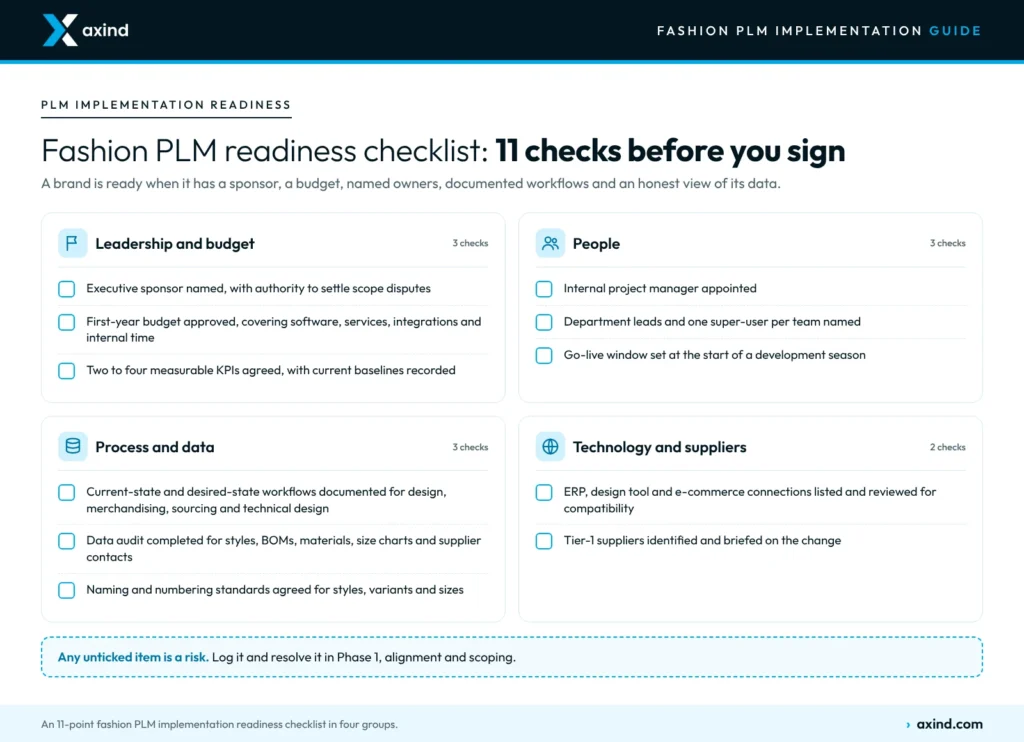
Leadership and budget
- Executive sponsor named, with authority to settle scope disputes First-year budget approved, covering software, services, integrations and internal time
- Two to four measurable KPIs agreed, with current baselines recorded
People
- Internal project manager appointed
- Department leads and one super-user per team named
- Go-live window set at the start of a development season
Process and data
- Current-state and desired-state workflows documented for design, merchandising, sourcing and technical design
- Data audit completed for styles, BOMs, materials, size charts and supplier contacts
- Naming and numbering standards agreed for styles, variants and sizes
Technology and suppliers
- ERP, design tool and e-commerce connections listed and reviewed for compatibility
- Tier-1 suppliers identified and briefed on the change
Wrap Up
A successful fashion PLM implementation comes down to five things: a clear scope, clean data, integrations tested early, a real pilot and a change plan that brings designers and suppliers along. Brands that follow the 5-phase roadmap, record KPI baselines before go-live, and retire old spreadsheets on a fixed date give their PLM the best chance of becoming the single source of truth for every style, cost and approval.
The right partner can shorten that journey. At Axind, we have built software for fashion and lifestyle supply chains since 2004, and today more than 100 fashion teams across over 20 countries run on our systems. Our Axind PLM+ platform brings planning, product data, sampling, costing, vendor collaboration, quality and compliance, and dashboards into one system. We configure it around each brand’s workflows, connect it to the ERP you already run, and most customer teams are fully operational within weeks. When you are ready to grow, PLM+ links to our WebTnA for manufacturing timelines, our SCM for orders and our OMNI platform for retail and e-commerce.
Our customers show what this looks like in practice. JOG Group has more than 60 designers working to one tech pack standard, Eurofins BLC runs more than 100 suppliers in one system, and One Friday runs its whole business on one platform. You can read more in our success stories.
If you are planning a PLM rollout for an upcoming season, we would be glad to review your current workflows and show how Axind PLM+ would fit. Our demos are built around your own workflows, supply chain and team structure, not a generic walkthrough.
Ready to plan your fashion PLM implementation? See Axind PLM+ work around your teams, suppliers, and workflows.
Book a Free Demo
Frequently Asked Questions (FAQs)
What is fashion PLM implementation?
Fashion PLM implementation is the process of configuring, integrating and deploying product lifecycle management (PLM) software across a fashion brand’s in-house teams and outside suppliers. It includes data migration, workflow setup, ERP and design tool integration, user training and supplier onboarding, so every style, bill of materials, cost and approval is managed in one shared system.
How much does it cost to implement a fashion PLM system?
Fashion PLM cost depends on users, modules and services. Johnson & Wales University, citing The Retail Exec, puts mid-market cloud PLM at about $80 to $150 per user per month, with implementation and training billed separately. For 25 users, that is roughly $24,000 to $45,000 a year in subscription fees. Enterprise licensing fees commonly reach five or six figures in US dollars a year before services.
How long does fashion PLM implementation take?
Fashion PLM implementation usually takes weeks for a mid-market brand on cloud software, and six months to more than a year for an enterprise suite. A sample mid-market plan reaches its first go-live in about 15 weeks across five phases. Clean data, early ERP integration, testing, and a stepwise rollout by category shorten the timeline most.
How do you get designers to adopt new PLM software?
Designer adoption comes from reducing disruption to creative work. Involve designers when workflows are scoped, train them on their upcoming styles, name a super-user on the design team, and use design tool plugins where the PLM offers them. Sending tech packs only through the PLM from a fixed date also stops old spreadsheets from staying in use.
Should you migrate all legacy data into a new PLM?
Most fashion brands should not migrate all legacy data into a new PLM. Migrate active styles, carryovers, current materials, and approved suppliers after cleaning and standardising them, and archive older seasons outside the system. Importing years of duplicate or inconsistent records recreates the same errors in the new PLM and slows the implementation.
Can fashion PLM software integrate with an existing ERP?
Most fashion PLM software can integrate with an existing ERP, so styles, BOMs and costs flow into purchase orders and inventory without re-keying. Design and test the application integration task during configuration, not after go-live. At Axind, we connect PLM to the legacy systems a brand already runs instead of asking it to replace them.
What are the phases of a fashion PLM implementation?
A fashion PLM implementation has five phases: alignment and scoping, data hygiene and migration, system configuration and integration, user acceptance testing and pilot, then go-live with supplier onboarding and continuous improvement. Each phase has a named owner and a clear output, such as a project charter in Phase 1 and a signed-off pilot in Phase 4.
Why do fashion PLM implementations fail?
Fashion PLM implementations most often stall because of unclear scope, messy legacy data, late ERP integration and weak change management. When designers and suppliers aren’t involved early, teams keep using spreadsheets and email alongside the new system, so the PLM never becomes the single source of truth.